


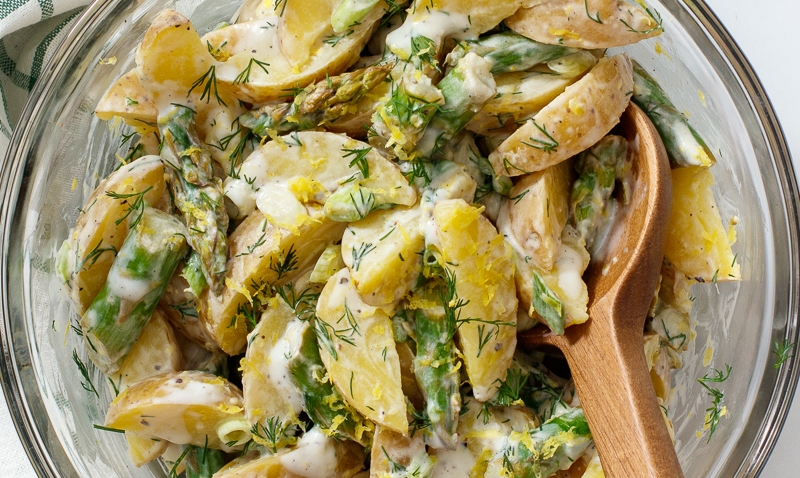
5 tips for terrific potato salad / Jill Silverman Hough
Spring has sprung, which brings us to outdoor eating (yay!), which brings us to, among other things, potato salad.
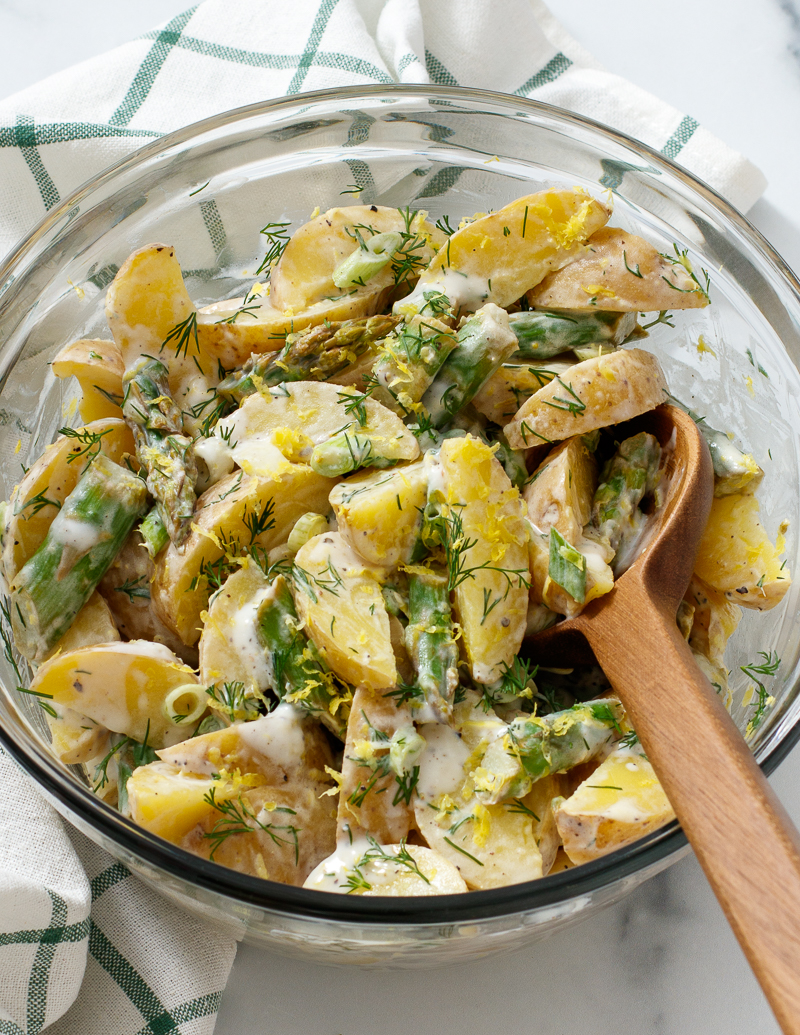
And potato salad is potato salad, right? Maybe not. I mean, there’s one way that most of us imagine it when we think of it. But there are lots of ways to make cut up, boiled potatoes into a delightful salad, whether it be my Spring Potato Salad with Asparagus and Lemon, a more traditional one, or something else. And as is often the case with cooking, small things can make a big difference.
Here, then, are some little ways to take your potato salad from good to great.
1. Cut the potatoes into same-size pieces.
This insures theyâll all be perfectly cooked at the same time, with no too-crunchy or too-mushy bites in the bunch.
2. Start the potatoes in cold water.
Dropping potatoes in already-boiling water can mean their outsides are done while the insides are still al dente. Instead, put them in a pot, cover with cold water by about an inch, and place the pot over high heat. The potatoes will come up to a boil slowly and each piece will be perfectly cooked inside and out.
3. Season the water.
Between adding the water and putting the pot on the stovetop, don’t forget this critical stepâseason the water with salt. Why? Because no matter how much salt you add later, when you toss your cooked potatoes with other ingredients, the potatoesâ insides will still be bland. Cooking them in salted waterâjust like when you cook pastaâwill help make each bite flavorful through and through.
How much salt? Make the water as salty as the ocean, about 1 tablespoon of coarse kosher salt or 1 1/2 teaspoons of fine salt per quart.
I knowâthatâs a lot of salt. But most of it gets poured off with the cooking water. And it really does take that much for enough to get into the potatoes and flavor them.
4. Stir in the dressing while the potatoes are still warm.
Right after you drain the potatoes, while theyâre still warm, theyâre most able to soak up your potato salad dressing. So add it nowâagain to help each bite be flavorful through and through.
5. Venture beyond the basics.
If you feel all warm and fuzzy making potato salad with mayonnaise and celery just like mom used to, by all means you should absolutely make it that way. Seriously. One of the biggest benefits of cooking is how it connects us to loved ones and memories and Iâd be the last person in the world to suggest missing out on those connections.
If, however, mayonnaise and celery donât elicit fuzziness, consider getting a little creative. Try adding seasonal veggies or herbs. Try different dressings. And try my Spring Potato Salad with Asparagus and Lemon or Summer Potato Salad with Green Beans, Corn, Lemon, and Olive Oil.
Potato salad isnât rocket science, and itâs certainly not anything to stress over. But since youâre making the effort, why not make it really pay off?
It could be the difference between good and great.
PakarPBN
A Private Blog Network (PBN) is a collection of websites that are controlled by a single individual or organization and used primarily to build backlinks to a “money site” in order to influence its ranking in search engines such as Google. The core idea behind a PBN is based on the importance of backlinks in Google’s ranking algorithm. Since Google views backlinks as signals of authority and trust, some website owners attempt to artificially create these signals through a controlled network of sites.
In a typical PBN setup, the owner acquires expired or aged domains that already have existing authority, backlinks, and history. These domains are rebuilt with new content and hosted separately, often using different IP addresses, hosting providers, themes, and ownership details to make them appear unrelated. Within the content published on these sites, links are strategically placed that point to the main website the owner wants to rank higher. By doing this, the owner attempts to pass link equity (also known as “link juice”) from the PBN sites to the target website.
The purpose of a PBN is to give the impression that the target website is naturally earning links from multiple independent sources. If done effectively, this can temporarily improve keyword rankings, increase organic visibility, and drive more traffic from search results.




Leave a Reply